
Thoughts on the art market from a collection or artistic ideals
The right fine art can be an investment with potential rewards far beyond any other. That includes real estate, stocks and commodities. Here is a perfect example: Andy Warhol silkscreen "200 One Dollar Bills" (that last sold more than two decades ago at Sothebys for $300,000) recently sold for $43.7 million — over three times its $12 million high estimate. So, in general, it is absolutely a smart investment to buy great fine art.
We hear more and more artists complaining nowadays though that — if you look around, you will find that the process of making great fine art, as defined throughout history by the masters like Da Vinci, Francisco Goya and Picasso, is slowly dying. The physicality and Renaissance spiritual presence is disappearing. It is not being killed off by techniquey installation art and short lived shock art like that of a Damien Hirst and/or the others in the Young British Artists (YBA) crew. That kind of art has been around for some time and it has its place in art's history, always has. The market IS getting diluted however, by digital fine art (the ultimate oxymoron). Programs like Photoshop and machines like 60" super wide, high-quality inkjet printers are starting to flood galleries with what are essentially printouts. This is hugely evident by examples that were sold at a previous show in LA, filmed in the recent documentary on street art titled: Exit Through The Gift Shop. What are art collectors thinking? Are they thinking? The hands of the artist have been removed from this process! These printouts are meaningless, empty and void of just about all artistic soul. Technology tools are in some ways destroying, not evolving, the fine art creation process as we know it. Pixel manipulating filters in software are making "artistic discovery" in the creation process a thing of the past. This artwork saturation and destruction is making traditional fine art even more rare than time does on its own. Unfortunately, there will come a day when it will be very infrequent to find individuals picking up pigments, paint and brushes to articulately manipulate imagery on a substrate like canvas or wood. In fact, there are less artists painting fine art now than there were 100 years ago. And 100 years from now there will be even less, much less.
When we asked Dennis his thoughts on these ideals, he stated:
"Technology has its place in my art. In my opinion, it's actually part of art's evolution. But it should be used carefully, maybe even sparingly; as one tool in the artist's toolbox. It [technology] should never become a crutch to substantiate artistic malaise."
Financially savvy individuals know fine art is the ultimate commodity. It is rare. It won't be melted down, reformed and reused like other commodities. In its originality and origin it is priceless.
So logically speaking, with less and less tangible artworks being produced today, naturally there will be less supply of it for the future. And we can easily deduce by the current growth in the investment size of the art market that demand continues to steadily increase. Therefore, decreasing supply of fine art and increasing demand to own it, by simple Economics 101 standards, equates to a favorable investment opportunity.
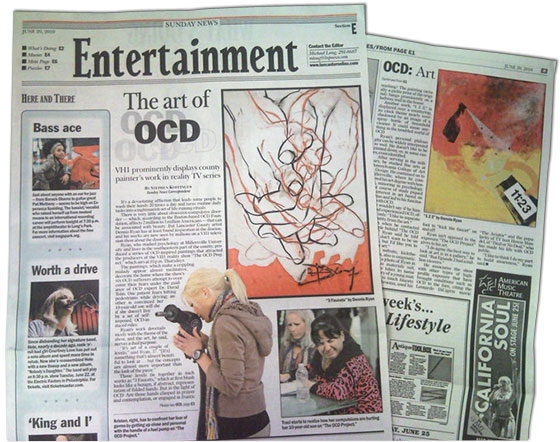
3 Faucets and 1 2 3 made the front page of the Entertainment section via a brilliant write up in The Lancaster [PA] Sunday News. The article was written by Stephen Kopfinger; who has high familiarity with OCD from a previous great article he did on Oprah's OCD Camp (with Dr. Oz and Philadelphia anxiety expert Dr. Jonathan Grayson). Here's an excerpt from the article: "Those levels tie together in such works as "3 Faucets," which at first blush looks like a benign, if abstract, representation of folded hands. But in the light of OCD: Are those hands clasped in prayer and contemplation, or engaged in frantic washing?"
Thoughts on Dennis Ryan's artwork and kickthefaucet.com
First off, this is not a sales pitch. This page was created by writers to simply help facilitate the rapidly growing number of requests for more information about conceptual art by Dennis Ryan. Traffic of interest is growing at an exponential rate from organic search and extraordinary art showing events (hint-hint: big one coming in early 2011, so stay tuned!). Most of the recent requests from this website's contact form have been for more information on how to go about purchasing these paintings and prints. Attention is good! So this content is here to help explain the process to people who are interested, and to share some thoughts, opinions and perspective on the art market in general.
Ryan's fine art focus subject matter, OCD (obsessive compulsive disorder), seems to be on a real tear in popularity nowadays.
Shows like Monk are in re-syndication and teen stars on popular Disney® sitcoms are saying "...I'm OCD, I'm OCD..." and laughing about it. OCD is now mainstream! Forget about the days when Howard Hughes was looked upon as an isolated freak. We now give a famous, admitted obsessive compulsive sufferer like Howie Mandel — not one — but three prime time shows (Deal Or No Deal, Howie Do It and now the new judge on America's Got Talent). Good for Howie and great for OCD. Fame has a way of raising awareness by bringing to light serious normal abnormalities via a quintessential few.
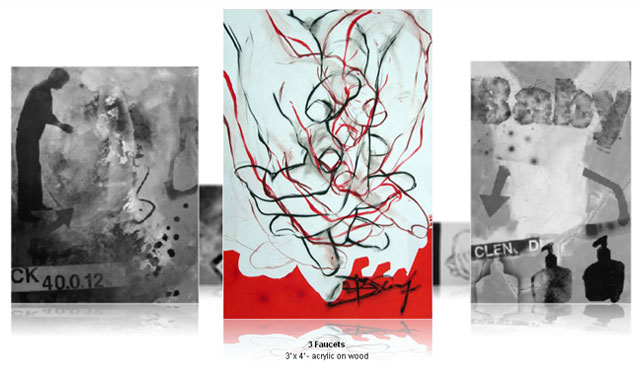
OCD Series Paintings — click on an image below for more information


The fine art paintings seen above conceptualize on psychological disorders, specifically obsessive compulsive disorder. The series currently consists of 6 paintings. The paintings are mostly on wood panels with medium of acrylics, Isopropyl Rubbing Alcohol, Windex® and adhered plastic.
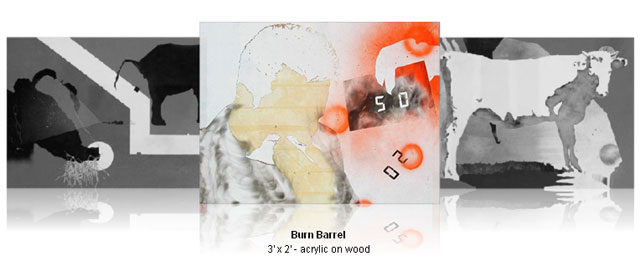
Phobia Series Gallery — click on an image below for more information


The fine art paintings seen above conceptualize on psychological disorders, specifically phobias. This series currently consists of 7 paintings. The paintings are entirely on wood panels with medium of oils, acrylics, Isopropyl Rubbing Alcohol, burned wood, woodcut techniques and masking tape.
The paintings in the OCD art series and phobia art series are some of the earliest pieces in Dennis Ryan's crusade to focus on psychological disorder concepts as an artist. He has been painting about these concepts for 15 years. If you have questions or comments on a painting, contact the artist here. The anxiety art series is a collection of the most recent artwork. Prolific intensity is building.
[an error occurred while processing this directive]Dennis Ryan artwork facts: conceptual art — paintings, prints & drawings
- Currently is working on an integration of faith (or lack there of) into his mental struggle concepts.
- Paintings live mostly in the tri-state area (New York, New Jersey and Pennsylvania).
- This art is receiving exponentially increasing interest — on a global scale — from private collectors, galleries, psychologists, psychiatrists, mental health societies, students and psychological disorder suffers alike.
- Check global search rankings — type these phrases into your favorite search engine and see:
- "Dennis Ryan"
- "paintings about psychological disorders"
- "OCD art"
- "conceptual fine artist"
- "up and coming fine artist"
- etc., etc., etc.
- Page 1 rankings are bringing this conceptual art huge amounts of attention on an international scale. Tens of thousands of viewers annually are being introduced to fine art that deals with anxiety, OCD, phobias and psychological disorders.
Gallery showings
Dennis is not actively pursuing galleries at this time. The Internet is currently his world-wide gallery stage. He's continuously looking into unconventional ways to show; as he feels the time is ripe and that there is currently a shift favoring the empowerment of artists on a global scale. But he will stay open to requests from "bricks & mortar" gallery owners. Galleries may feel free to submit interest in this fine art through the contact form. Persuasive, interested galleries will be addressed on a case by case basis. As an up and coming artist Dennis will be most likely to show in NYC (SoHo), Raleigh-Durham, NC, Chicago, IL, Los Angeles, CA and Philadelphia, PA area when invited.
Again, at this point the artist is focused on Google as his main gallery representative. With 2 billion search queries submitted a day, he will gladly focus his spare energies there. Ryan is also looking into other unconventional ways to show his work and get his conceptual voice heard. Technology is the wind at his back and there has never been a better time to excel as an artist. Dennis is very confident, content and comfortable with this global gallery setup for now: essentially, he is now an international fine artist with thousands of hits, submissions and questions monthly. Demand and interest in OCD, anxiety and phobia fine art is growing across the world — as far east as New Zealand & Australia and as far west as Alaska.